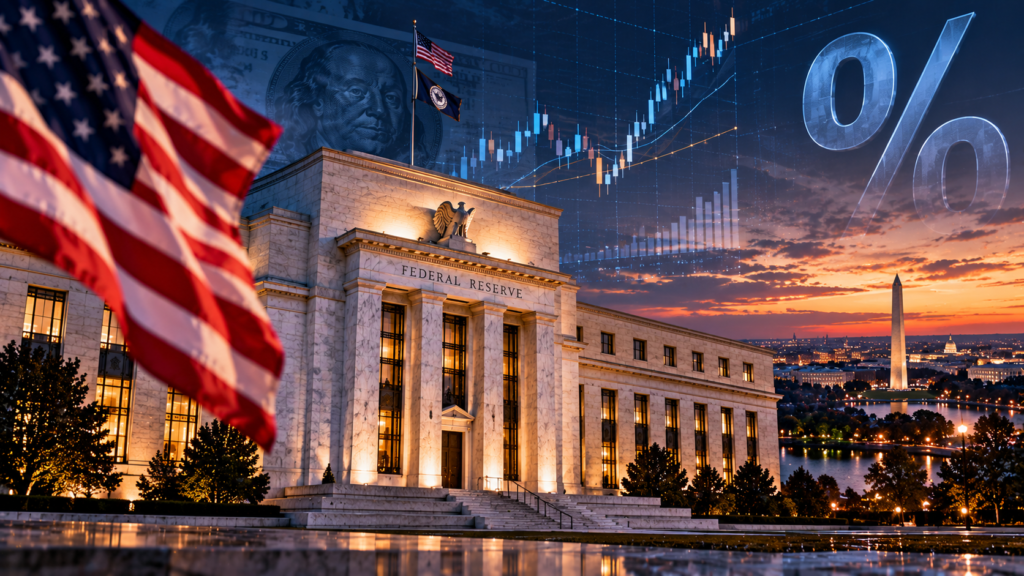
The Federal Reserve is widely expected to leave interest rates unchanged at its October meeting before raising borrowing costs again in December, according to a Reuters poll of economists. The survey, conducted from October 16 to 20, found that 94 of 100 respondents expected the Fed to maintain its target range at 3.75%–4.00% on October 27–28, while all 100 anticipated another increase in December.
The outlook points to a difficult balancing act for policymakers: allowing more time to assess incoming economic data while confronting inflation that remains above the central bank’s 2% target.

Why the Fed May Wait
The expected October pause does not necessarily signal that inflation risks have eased. Instead, it reflects the Fed’s preference to assess the effects of its September rate increase before tightening policy again.
The US economy has remained resilient, supported by consumer spending and investment in artificial intelligence infrastructure. At the same time, higher energy costs and tariffs have contributed to persistent price pressures, complicating the central bank’s efforts to restore price stability.
A pause would give policymakers additional time to evaluate inflation, employment and economic growth before making another decision. However, waiting too long could allow price pressures to become more entrenched, potentially requiring a more aggressive response later.
Inflation Remains the Central Challenge
The Fed’s policy dilemma is increasingly shaped by the persistence of inflation rather than a lack of economic growth. The Reuters survey indicated that economists expect inflation to remain more than one percentage point above the Fed’s 2% target over coming quarters, with a return to target not expected until at least 2028.
That outlook strengthens the case for keeping monetary policy restrictive. Higher interest rates make borrowing more expensive, reducing demand and helping to slow price increases. The downside is that prolonged tightening can also weigh on investment, housing activity and consumer spending.

The policy debate is therefore not simply about whether rates should rise, but how quickly the Fed should act. A measured approach could limit unnecessary economic disruption, while a delayed response risks requiring larger increases later.
What Higher Rates Mean for Markets
A December increase would have implications across financial markets, although the reaction will depend on how much investors have already priced in.
- Stocks: Higher borrowing costs can reduce company valuations by increasing financing expenses and lowering the present value of future earnings. Growth stocks may be particularly sensitive.
- Bonds: Rising yields generally push the prices of existing fixed-rate bonds lower. Shorter-term Treasury yields tend to react strongly to changes in expected Fed policy.
- The US dollar: Higher US yields relative to those in other economies can support the dollar, although currency movements also depend on global risk appetite and foreign central-bank decisions.
- Real estate: Mortgage rates and property financing costs may remain elevated, potentially limiting affordability and investment activity.
- Savings: Higher rates can improve returns on some cash deposits and short-term instruments, depending on how quickly financial institutions pass on changes.
These effects are not automatic. Markets respond to the difference between expectations and actual policy decisions, meaning even an anticipated rate increase can trigger volatility if the Fed’s guidance surprises investors.
December Is Not Guaranteed
Although all 100 economists in the survey expected another increase in December, the poll represents a consensus forecast rather than a commitment by the Federal Open Market Committee.
The final decision will depend on incoming inflation readings, employment conditions, consumer demand and financial-market developments. Policymakers could change course if inflation cools more quickly than expected or if economic conditions weaken materially.
The survey also revealed disagreement over how far tightening might go. Nearly 60% of forecasters expected the policy rate to peak at 4.00%–4.25%, while 38 of 92 respondents anticipated at least two additional increases.
That uncertainty matters for investors planning portfolios around a prolonged period of higher interest rates.
The Bigger Picture
The Fed faces a familiar but increasingly difficult trade-off: bringing inflation under control without unnecessarily weakening economic activity. An October pause would offer temporary stability, but the prospect of a December increase suggests policymakers may not yet be confident that inflation is moving sustainably towards their target.
For investors, the key signal is that lower borrowing costs may not arrive soon. Businesses, households and portfolio managers may need to plan for a financial environment in which capital remains relatively expensive and market sensitivity to economic data stays elevated.
The next major turning point will be whether inflation begins to moderate enough to change the Fed’s outlook—or instead forces policymakers to tighten further.
Sources
- Reuters — Fed to Skip October but Raise Rates Again in December, Nearly All Economists Say — Original economist survey, October 20, 2026.
- Federal Reserve — Monetary Policy — Official policy information and rate decisions.
- Reuters — Fed Officials Weigh Further Rate Increases — Background on policymakers’ views and inflation risks.
- J.P. Morgan Global Research — Federal Reserve Rate Outlook — Broader analysis of interest rates and monetary policy.