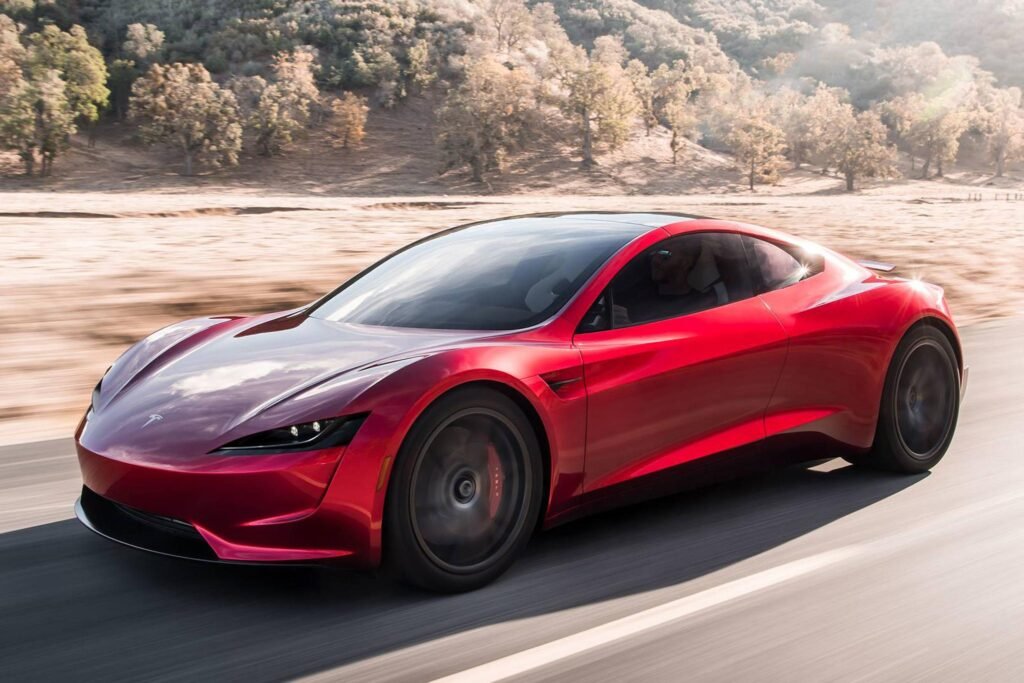
Tesla has unveiled a redesigned Roadster that pushes the boundaries of electric-car engineering, demonstrating short bursts of flight using compressed-air thrusters, mid-air manoeuvres and acceleration from 0 to 60 mph in less than one second. The presentation, held at a SpaceX facility in Texas on October 15, 2026, gave investors and automotive enthusiasts a glimpse of a vehicle designed to stand apart from conventional supercars.
The demonstration also helped revive attention around Tesla’s long-delayed sports car, although commercial production is still targeted for 2028.
A Supercar That Can Take Off

The most striking feature of the new Roadster is its use of cold-gas thrusters, which release compressed gas to generate short bursts of thrust. During the demonstration, the car launched from a specially designed ramp, rotated in mid-air and used its propulsion system to help control its orientation before landing.
Tesla also showcased a stunt involving the vehicle jumping over other cars, including a Tesla Semi. A multi-mode suction system was presented as another unusual feature, designed to help the car maintain contact with surfaces during specialised manoeuvres.
These demonstrations are intended to showcase technology that goes beyond the capabilities of a traditional electric sports car. However, the short airborne movements shown at the event should not be confused with sustained flight or the ability to operate as a conventional aircraft.
Acceleration Below One Second
Tesla reported that the Roadster completed a 0–60 mph acceleration test in 0.81 seconds. Chief Executive Elon Musk also discussed a potential top speed of Mach 0.5 for a future production version, equivalent to roughly 383 mph under standard atmospheric conditions.
These figures are extraordinary claims, but they need to be distinguished from independently verified specifications for a production vehicle. Actual performance will depend on the final configuration, operating conditions and whether the demonstrated technology can be delivered reliably in a road-legal car.
Tesla has outlined three versions: Performance, Thrust and Rocket. The latter is designed around the most ambitious propulsion features, including thrusters intended to enable limited airborne movement. The configurations are aimed at different levels of performance rather than a single mass-market product.
Production Still Years Away
Despite the dramatic presentation, buyers will have to wait. Tesla is targeting the start of production in 2028, more than a decade after the second-generation Roadster was first announced in 2017.
The project has experienced repeated delays, and Tesla has not yet established a firm delivery schedule for customers. Pricing and availability also remain important considerations, particularly for the most advanced configuration.
The company’s challenge is to turn an attention-grabbing prototype into a reliable, manufacturable vehicle that can meet applicable safety and road-use requirements. The thruster-equipped versions may face additional regulatory questions because their capabilities extend beyond those of ordinary road cars.
Investors Focus on the Technology
Tesla shares rose as much as 5.4% in premarket trading following the unveiling, reflecting an initially positive market reaction. The move suggests that the Roadster reveal attracted investor interest, even though the vehicle is unlikely to become a high-volume product.
For Tesla, the Roadster could function as a technology showcase: a premium vehicle designed to demonstrate engineering ambition, attract attention to the brand and reinforce the company’s broader innovation narrative.
The commercial impact remains uncertain. A low-volume supercar is unlikely to transform Tesla’s financial performance on its own, and investors will still need to evaluate vehicle demand, margins, competition and the company’s execution across its core businesses.
Innovation Versus Execution
The new Roadster is an ambitious attempt to redefine what an electric sports car can do. Its compressed-air propulsion system, unusual manoeuvres and claimed acceleration figures make it one of the most unconventional vehicles Tesla has presented.
But the key test lies ahead. Production in 2028 remains a target, and the final vehicle’s price, performance, regulatory status and customer delivery timeline will determine whether the demonstration becomes a commercially meaningful achievement.
For now, Tesla has delivered a memorable showcase. Turning that spectacle into a practical, road-legal product will be the more difficult task.