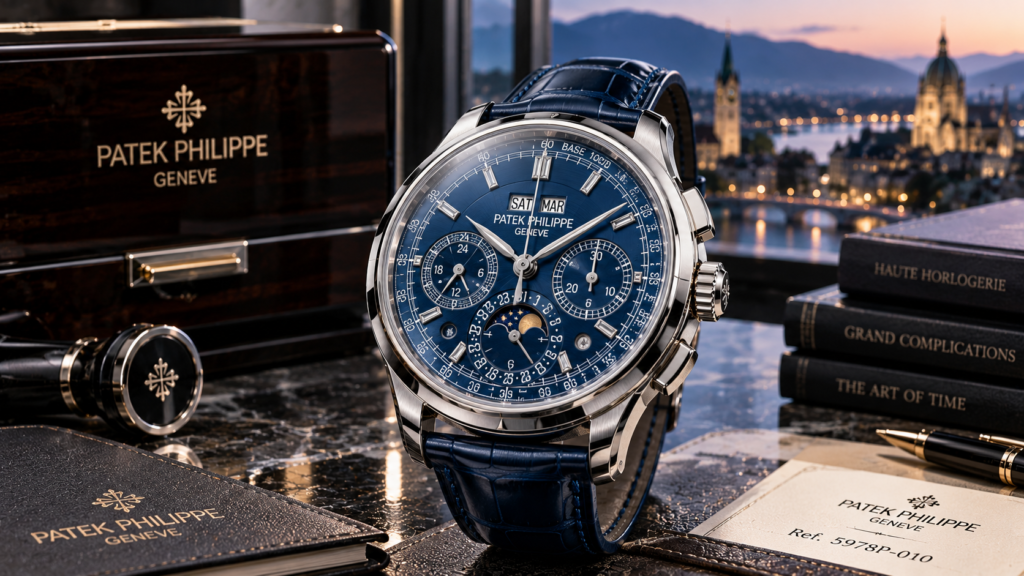
Patek Philippe’s Ref. 5978P-010 demonstrates how traditional watchmaking reaches the $300,000-plus tier. Combining a hand-wound chronograph with an instantaneous perpetual calendar, the platinum limited edition introduces a new movement architecture while continuing a lineage of complicated watches that stretches back decades.
◉ 500 movement components: The new CH 29-535 PS QI calibre combines chronograph timing with an instantaneous perpetual calendar.
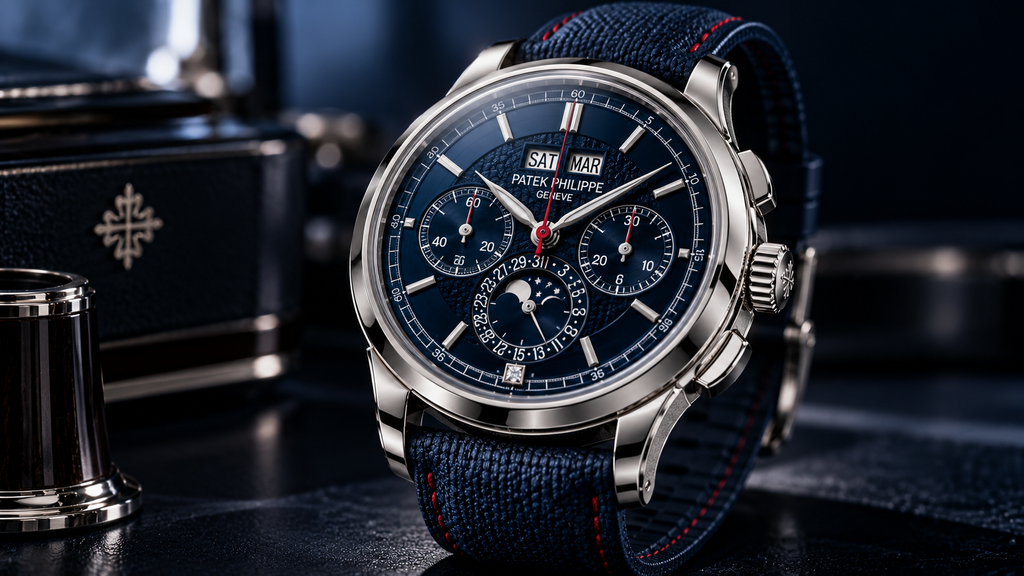
◉ Platinum construction: A polished 42 mm platinum case, navy-blue dial and discreet diamond at six o’clock define the watch’s premium execution.
◉ Limited to 120 pieces: Created for the Watch Art Grand Exhibition in Milan, the reference carries an official US price of $337,585.
The Price of Complexity
Luxury-watch prices at the highest level are rarely explained by material costs alone. Platinum, hand finishing and limited production all contribute, but the engineering required to combine several precise mechanical functions within a wristwatch is central to the grand-complication category.
The Ref. 5978P-010 brings together two demanding mechanisms: a column-wheel chronograph and an instantaneous perpetual calendar. The chronograph measures elapsed time, while the perpetual calendar tracks the day, date, month and leap-year cycle without requiring routine manual correction during normal operation.
The model was introduced for Patek Philippe’s Watch Art Grand Exhibition in Milan in October 2026. Its limited production of 120 pieces also connects it to a specific event and market, rather than positioning it as an unrestricted addition to the regular collection.
A New Calibre
At the heart of the watch is the manually wound CH 29-535 PS QI. Its 500 components are arranged to coordinate the chronograph with the calendar’s instantaneous indications.
The calendar’s defining feature is the simultaneous jump of its displays. Instead of advancing gradually, the day, date, month and leap-year indications change together in approximately 30 milliseconds. Achieving this requires energy to be accumulated and released in a tightly controlled sequence, while maintaining reliable operation as the mainspring unwinds.
The movement also includes an instantaneous 30-minute chronograph counter, moon phases, small seconds and a day-night indication. It beats at 28,800 vibrations per hour and offers a power reserve of approximately 55 to 65 hours when the chronograph is disengaged.
Its construction draws on Patek Philippe’s established chronograph architecture and its previous work on instantaneous calendar mechanisms. The result is not simply a watch with more indications, but a movement designed to make several complex functions operate in coordination.
Platinum and Precision
The 42 mm case is crafted from platinum and finished with polished surfaces, a concave bezel and sculpted lugs. A small diamond set at six o’clock follows a familiar signature of Patek Philippe’s platinum watches.
The navy-blue dial features a sunburst finish, a textured centre and a black-gradient perimeter. White-gold hour markers contrast with the red chronograph hands, while calendar information appears in apertures framed by applied white gold. The day and month are displayed in Italian, reflecting the watch’s Milan exhibition connection.
A navy composite strap with a textile-inspired pattern and red stitching gives the watch a sportier appearance than its traditional precious-metal construction might suggest. The sapphire caseback, marked for Milan 2026, exposes the movement’s finishing.
What Drives the $337,585 Price?
The official US price is $337,585. The European price reported by specialist watch publications is approximately €318,000, although the exact amount depends on the market and tax treatment.
The price reflects several overlapping factors: the platinum case, the complex manually wound movement, the engineering required for instantaneous calendar changes, hand finishing, the brand’s position in haute horlogerie and the edition’s restricted production.
Scarcity is part of the positioning, but it does not independently guarantee future resale value. Nor can the retail price be explained by counting components alone. The more meaningful distinction is the time, expertise and precision required to develop, assemble, regulate and finish a mechanism of this complexity.
A Legacy of Grand Complications
Patek Philippe’s history of combining a chronograph and perpetual calendar in a wristwatch dates back to the Ref. 1518, introduced in 1941. Later references developed the concept through successive generations of movements and case designs.
The Ref. 5978P-010 advances that tradition by pairing the hand-wound chronograph with an instantaneous perpetual calendar in a new configuration. Its significance lies in how those mechanisms are integrated, rather than in a single headline specification.
At more than $300,000, the watch occupies a narrow segment of the market where mechanical sophistication, finishing, heritage and exclusivity converge. It illustrates how traditional watchmaking can command a premium when several complex systems are engineered into a single, coherent instrument.
Sources
- Patek Philippe — Official Ref. 5978P-010 product page
- WatchTime — Instantaneous Perpetual Calendar Chronograph
- Hodinkee — Patek Philippe Ref. 5978P introduction and pricing
- Monochrome Watches — Technical review of the Ref. 5978P-010
- Denarni Fokus — Editorial Disclosure & Transparency