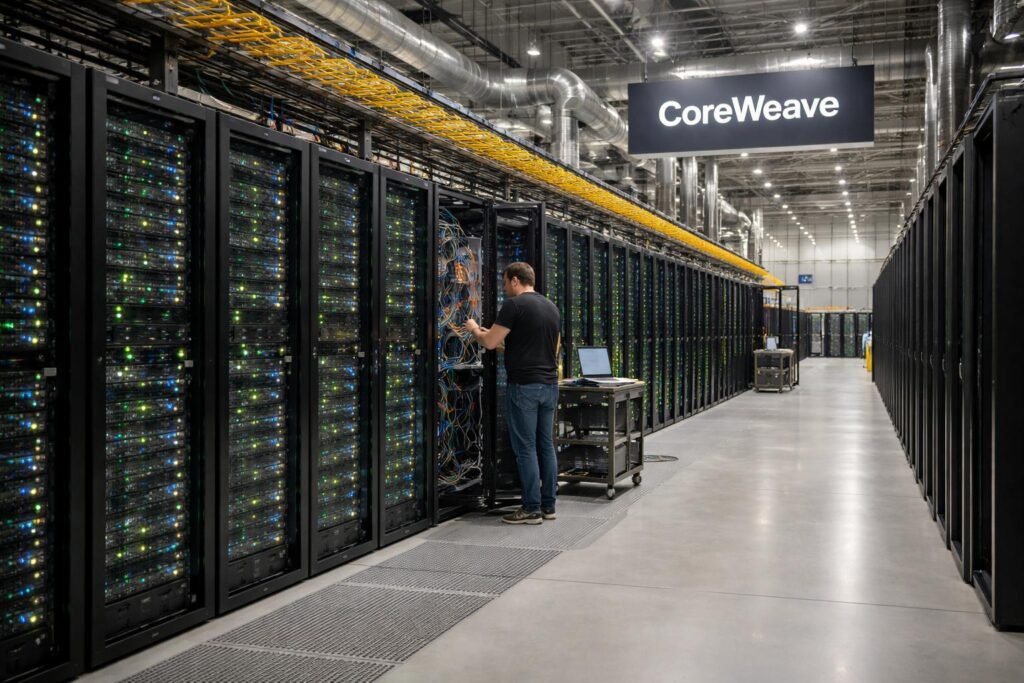
CoreWeave shares advanced on Monday after Goldman Sachs upgraded the artificial intelligence infrastructure provider from Neutral to Buy, arguing that constrained computing capacity and the company’s competitive position could support stronger recurring revenue per megawatt over the next two years. The upgrade followed a sharp sell-off that had erased more than a quarter of the stock’s value during the previous week.
The move highlights a central tension in the AI investment boom: demand for computing infrastructure remains strong, but the cost of building that capacity is raising questions about financing, profitability and returns on capital.
Goldman’s more positive rating does not mean those risks have disappeared. The bank also lowered its price target, from $139 to $106, while upgrading the stock, according to reporting by Investing.com.
Why Goldman Sachs Turned More Positive
Goldman’s upgrade centres on the relationship between limited computing supply and the economics of AI infrastructure. CoreWeave operates specialised cloud infrastructure designed to run demanding workloads, including training and deploying AI models.
When advanced computing capacity is scarce, providers with available infrastructure and strong customer relationships may be able to negotiate more attractive contract terms. Goldman expects CoreWeave’s annual recurring revenue per megawatt to increase as demand and pricing evolve over the next two years.
The company has already reported signing new short-term contracts in the third quarter at approximately $40 million per megawatt on an annualised basis. CoreWeave also announced more than $25 billion in additional net customer commitments early in the quarter, alongside an increase in contracted power capacity. These figures point to strong commercial demand, although short-term pricing does not guarantee equivalent revenue or profitability over the long term.
The Debt Burden Remains the Biggest Concern
CoreWeave’s rapid expansion requires substantial upfront investment in computing equipment, data centres and supporting infrastructure. Borrowing has helped finance that growth, but it also exposes the company to higher interest expenses and changing credit-market conditions.
The company reported approximately $35.6 billion in total indebtedness as of 30 June 2026, according to its regulatory filing. Its expansion strategy therefore depends not only on securing customers, but also on managing repayments, financing new projects and generating sufficient cash flow as infrastructure comes online.
The pressure became visible in the bond market during the recent sell-off. The yield on CoreWeave’s bond maturing in 2031 rose above 16% last week before easing to approximately 15.13% on Monday. Such elevated yields indicate that creditors are demanding substantial compensation for the risks associated with the company’s debt.

Strong Contracts Do Not Guarantee Strong Profits
CoreWeave has secured major commitments from large technology customers, including Microsoft, OpenAI and Meta. These relationships provide visibility into potential future demand, but fulfilling contracts requires continued investment in computing capacity and the associated infrastructure.
Customer concentration is another consideration. Microsoft’s share of CoreWeave’s 2025 revenue was approximately 67%, according to company filings reported by Reuters. A relatively concentrated customer base can create risk if a major client changes its spending plans, renegotiates contracts or shifts workloads elsewhere.
The central question for investors is whether the economics of these contracts can generate returns that justify the cost of financing and deploying the infrastructure. Rising revenue per megawatt could improve the outlook, but utilisation rates, operating costs, depreciation and interest expenses will all influence the eventual results.
What the Upgrade Means for Investors
Goldman Sachs’ decision to upgrade CoreWeave despite lowering its price target illustrates the distinction between a more favourable view of a company’s prospects and a reduction in its estimated valuation.
The bullish argument is that scarce AI computing capacity and strong customer demand could improve pricing and investment returns. The bearish argument is that expensive financing, substantial capital requirements and execution risks could absorb much of the economic benefit.
Monday’s rebound followed an exceptionally difficult week for the stock, making it important to distinguish a relief rally from a sustained improvement in investor confidence. Developments in the credit market may be just as important as changes in the share price.
What Investors Should Watch
- Recurring revenue per megawatt: Whether new contracts deliver sustained improvements in pricing and revenue.
- Debt financing costs: Whether bond yields and borrowing costs decline from elevated levels.
- Customer commitments: Whether contracted demand translates into deployed capacity and recognised revenue.
- Cash flow and profitability: Whether operating cash generation improves as infrastructure investment expands.
- Customer concentration: Whether CoreWeave broadens its revenue base beyond its largest clients.
CoreWeave remains closely tied to the expansion of AI computing infrastructure. Goldman Sachs’ upgrade reflects the potential benefits of constrained supply and improving contract economics, but the company’s debt burden remains a critical part of the investment case. A durable recovery will depend on converting strong demand into sustainable cash generation and returns on capital.
This article is for informational purposes only and does not constitute investment advice.
Sources
- Reuters — AI stocks bounce back after bruising sell-off; CoreWeave gets Goldman upgrade — 19 October 2026. Stock performance, Goldman Sachs’ upgrade and bond-market developments.
- Investing.com — CoreWeave jumps as Goldman Sachs upgrades stock after 25% rout — 19 October 2026. Revised price target and rationale for the rating change.
- U.S. SEC — CoreWeave quarterly filing — Financial statements, debt obligations and liquidity as of 30 June 2026.
- CoreWeave Investor Relations — New compute capacity at higher prices — 17 September 2026. Contract pricing, customer commitments and contracted power capacity.