Short description: Severe weather and poor visibility forced organisers to cancel all three premier championship races at Phillip Island on Sunday, 25 October 2026. The decision followed repeated delays and the loss of a safe operating window for the medical helicopter. The cancellation also overshadowed a historic farewell to one of MotoGP’s most celebrated circuits, with the Australian Grand Prix scheduled to move to Adelaide in 2027. Australian Motorcycle Grand Prix 2026
◉ Safety overrides the schedule: The MotoGP, Moto2 and Moto3 races were cancelled because poor visibility prevented the medical helicopter from operating safely. Organisers said racing could not proceed without the required medical cover. Australian Motorcycle Grand Prix 2026
◉ Refunds confirmed: The Australian Grand Prix Corporation said it was working with ticketing partners to provide full refunds for Sunday-only ticket holders and partial refunds for multi-day ticket holders. Australian Motorcycle Grand Prix 2026
◉ A difficult farewell: The cancellation came during Phillip Island’s final scheduled year on the MotoGP calendar. Riders were due to complete a farewell lap behind the safety car before the event’s move to Adelaide in 2027. Reuters
Safety Comes Before the Schedule
The cancellation followed several attempts to delay the programme in the hope that visibility would improve. The morning warm-up was called off, and the Moto2 and Moto3 races were cancelled before organisers abandoned the premier-class Grand Prix.
The medical helicopter was central to the decision. Phillip Island is more than 45 minutes by road from the nearest suitable hospital, making air transport an important part of the event’s emergency response arrangements. Without the ability to deploy the helicopter safely, organisers could not provide the required level of medical cover.
The decision illustrates a fundamental feature of major motorsport: the event schedule remains conditional on safety requirements, even when thousands of spectators have travelled to attend and substantial commercial commitments are involved.
It also highlights the operational complexity of hosting racing at a coastal circuit, where weather and visibility can change quickly and affect multiple parts of an event simultaneously.
The Financial Impact Beyond the Track
A cancelled race affects more than the sporting calendar. Promoters, teams, broadcasters, hospitality operators, vendors and local businesses all depend on different elements of the event taking place as planned.
For the organiser, the immediate questions include ticket refunds, contractual obligations, staffing and venue costs, as well as arrangements with commercial partners. Teams and broadcasters must also manage travel, logistics and programming around a race that never takes place.
Local businesses face a different challenge. Hotels, restaurants, transport providers and tourism operators may have prepared for demand associated with race day. Some expenditure by visitors will already have occurred, while other spending may be lost, reduced or redirected.
However, the cancellation alone does not establish the total financial loss. Some costs are fixed, some payments may be recovered through contracts or insurance, and the wider weekend can still generate economic activity even when Sunday’s races are cancelled. A credible estimate would require information about event finances, refund liabilities, insurance arrangements and local visitor spending.
That distinction is important when assessing the commercial consequences. The immediate disruption is clear, but a reliable estimate of the net economic impact requires more than the value of tickets or the number of races abandoned.
Refunds and Fan Experience
The Australian Grand Prix Corporation confirmed that it was working with ticketing partners to facilitate full refunds for Sunday-only ticket holders and partial refunds for multi-day ticket holders.
The policy provides a defined response for fans affected by the cancellation, although the practical process depends on ticket type and the arrangements communicated by the ticketing partners.
For major sporting events, refund policies are part of the relationship between organisers and their customers. Clear communication can help reduce uncertainty during a difficult situation, particularly when spectators have also paid for accommodation, transport and other travel expenses.
Ticket refunds do not necessarily cover every cost associated with attending an event. Those additional expenses depend on the terms offered by hotels, airlines and other providers, as well as any relevant insurance.
The broader challenge for event organisers is balancing the unpredictability of outdoor sport with the expectations of spectators who have purchased access to a scheduled programme.
Phillip Island’s Final Chapter
The cancellation carried particular significance because 2026 was scheduled to be Phillip Island’s final year on the MotoGP calendar after approximately three decades as the home of the Australian motorcycle Grand Prix.
The circuit is known for its coastal setting, fast corners and distinctive racing character. Its departure therefore represents more than a change of venue: it closes a long-running chapter in the championship’s Australian history.
Organisers arranged a farewell lap behind the safety car, allowing riders to acknowledge fans who remained at the circuit despite the weather. The gesture could not replace the cancelled competition, but it offered a final on-track moment for a venue whose identity has become closely associated with MotoGP.
The change also creates a transition for the event’s commercial ecosystem. Sponsors, hospitality providers, local businesses and spectators will have to adjust to a different location, with potential implications for travel patterns, visitor experiences and event operations.
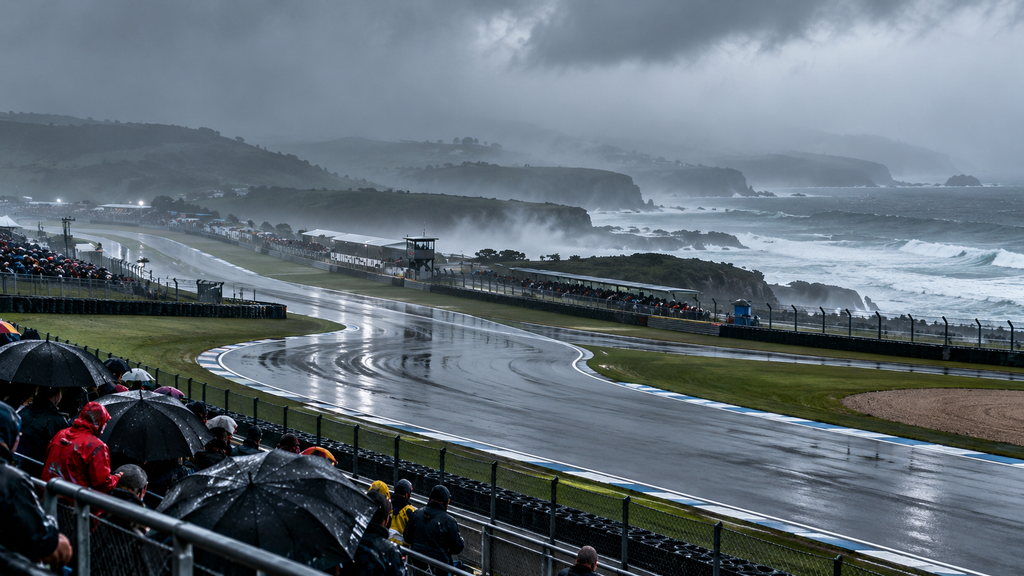
Illustrative AI-generated coastal racetrack scene, not a photograph of Phillip Island.
Adelaide Takes the Next Turn
The Australian Grand Prix is scheduled to move to an Adelaide street circuit in 2027. The change will give the event a new urban setting and a different operational model from Phillip Island’s established permanent circuit.
A street race can create new opportunities for destination marketing, hospitality and city-centre engagement. It also presents different logistical requirements, including temporary circuit infrastructure, road closures, crowd management and coordination with the surrounding urban environment.
The commercial outcome will depend on how the new event is organised and how audiences respond. A move to a city circuit does not automatically guarantee higher attendance, greater sponsorship value or a larger economic contribution.
Phillip Island’s final weekend instead demonstrates the importance of the venue itself to a major sporting event. Circuit characteristics, location, access, local support and the atmosphere experienced by fans all contribute to its identity.
For Adelaide, the challenge will be to establish a distinctive event while meeting the safety and operational demands of international motorcycle racing.
Broadcasting and Commercial Commitments
A race cancellation also disrupts the broadcast product. Rights holders and production teams plan coverage around scheduled sessions, while advertising and sponsorship exposure may be linked to particular parts of the programme.
When races are cancelled, broadcasters may need to adjust schedules, fill airtime with analysis or archive material, and communicate the decision to audiences across different time zones. The commercial consequences depend on the relevant agreements, including any provisions governing force majeure, replacement content or missed exposure.
Sponsors may also need to reconsider planned activations. A brand expecting visibility during a race loses that specific opportunity, although coverage of the cancellation, the weather and the farewell to Phillip Island can still attract attention.
The episode highlights a basic feature of live sport: the audience and commercial value are built around an event that cannot be guaranteed regardless of the planning and investment behind it.
For organisers and partners, resilience depends partly on contingency planning, clear communication and contracts that define responsibilities when conditions prevent competition.
A Difficult Ending, Not a Financial Verdict
The Australian Grand Prix’s cancellation was first and foremost a safety decision. Poor visibility prevented the medical helicopter from operating safely, leaving organisers without the required emergency-response capability to stage the races.
The immediate consequences are clearer than the financial ones. Sunday’s MotoGP, Moto2 and Moto3 races did not take place, refund arrangements were announced, and Phillip Island’s final scheduled appearance on the championship calendar ended without a competitive Grand Prix.
The longer-term implications will depend on the transition to Adelaide, the response of fans and commercial partners, and the financial arrangements surrounding the cancelled programme.
For the sports business sector, the weekend is a reminder that weather risk is not simply a scheduling problem. It affects the entire event ecosystem—from safety and broadcasting to ticketing, sponsorship and local tourism. The scale of those consequences can only be established once the relevant financial and operational details are available.
Sources
- MotoGP — Official race cancellation announcement
- Australian Grand Prix Corporation — Official statement and ticket refund arrangements
- Reuters — Australian Grand Prix called off as rain spoils Phillip Island send-off
- ABC News Australia — Final MotoGP race at Phillip Island washed out
- Motorsport.com — Australian GP cancelled after weather delays