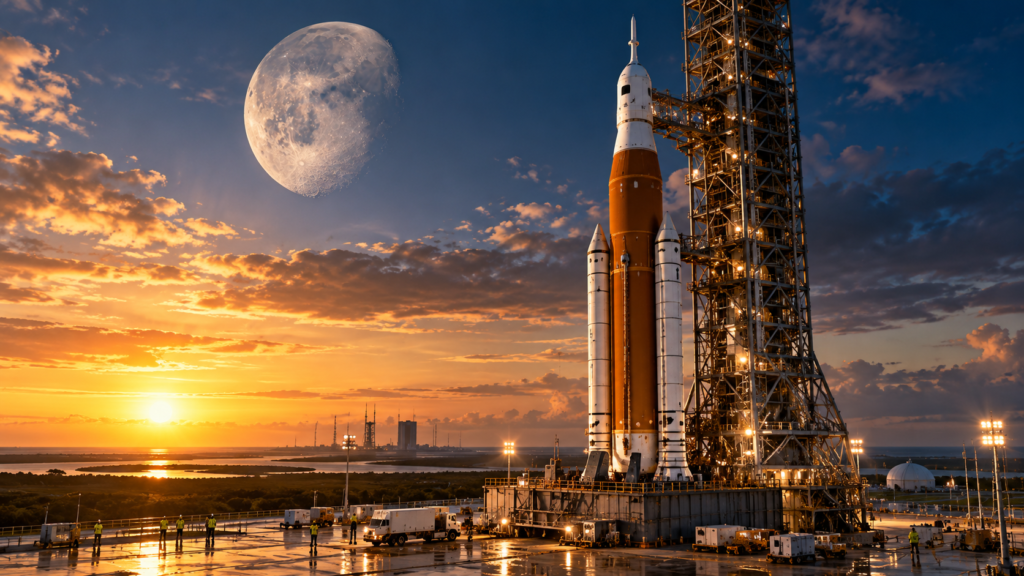
NASA is pressing ahead with its revised Artemis lunar programme, targeting a return of astronauts to the Moon by 2028 despite hardware readiness concerns and the complex work required from commercial contractors. The agency’s latest plan shifts the next major crewed test mission into Earth orbit, where astronauts will evaluate spacecraft and docking systems before a future lunar landing attempt.
◉ Moon landing targeted for 2028: NASA continues to aim for a crewed lunar landing under Artemis IV, while Artemis III is planned for 2027 as a critical systems-demonstration mission.
◉ SpaceX and Blue Origin face key tests: Both companies are developing lunar landers that must demonstrate readiness before carrying astronauts to the lunar surface.
◉ Engineering execution remains decisive: NASA is changing mission architecture and accelerating development, but schedule ambitions still depend on hardware testing, safety certification and contractor performance.
Artemis III Becomes a Critical Test
The revised mission plan reflects a major change in how NASA intends to return astronauts to the lunar surface. Rather than attempting a crewed landing on Artemis III, the agency plans to use the mission to test essential systems in low Earth orbit during 2027.
The four-person crew is expected to practise rendezvous and docking operations involving NASA’s Orion spacecraft and test versions of lunar landers developed by SpaceX and Blue Origin. The mission is designed to evaluate spacecraft compatibility, communications, navigation and operational procedures before a lunar landing is attempted.
This approach creates an additional stage between spacecraft development and a crewed landing. It also gives engineers an opportunity to identify technical problems under real spaceflight conditions, rather than relying entirely on ground-based simulations.
The broader objective remains a crewed return to the Moon in 2028, with Artemis IV now designated as the first planned lunar landing mission under the revised architecture.

Hardware Readiness Remains the Central Challenge
NASA’s schedule depends on several complex systems reaching operational readiness at the same time. Orion must support crew operations, the Space Launch System must provide reliable launch capability, and at least one commercial lunar lander must meet NASA’s requirements for a crewed mission.
SpaceX’s Starship programme faces particular engineering demands because its lunar architecture relies on orbital refuelling, involving the transfer and management of cryogenic propellant in space. The company must demonstrate that these operations can support a mission to the Moon and a safe return.
Blue Origin is developing its Blue Moon lunar lander using a different approach, with NASA outlining revised transfer-stage operations intended to support the 2028 schedule. Both providers must complete uncrewed demonstrations and satisfy NASA’s safety and certification requirements before astronauts can rely on their vehicles.
These challenges are not unusual for complex human-spaceflight programmes. However, the tight sequencing of launches, docking operations and lander preparation leaves limited room for unresolved technical issues. A problem in one system can affect the wider mission, even if the other components are progressing as planned.
The Commercial Space Economy
The Artemis programme is also a major industrial undertaking, linking public-sector research and exploration with private aerospace development. NASA’s contracts support engineering, manufacturing, propulsion, launch infrastructure, robotics and other specialised technologies.
For contractors, the programme provides substantial long-term opportunities, but it also creates execution risk. Development delays, design changes and additional testing can increase costs and push revenue milestones into later periods. Progress announcements therefore need to be assessed alongside hardware delivery, completed tests and contract requirements.
The programme’s commercial implications extend beyond the two lunar-lander developers. Launch providers, suppliers of avionics and communications equipment, spacesuit manufacturers and companies developing lunar surface systems all participate in the wider ecosystem.
NASA’s effort to accelerate the programme could create opportunities for suppliers capable of delivering flight-ready hardware on schedule. At the same time, the agency’s revised mission architecture illustrates how government programme decisions can alter contractor priorities and development timelines.
Science Beyond the Moon
The Artemis programme is also intended to establish capabilities that could support longer-term exploration, including missions to Mars. Operations around the Moon offer an environment in which NASA and its partners can test life-support systems, crew procedures, communications and spacecraft integration beyond low Earth orbit.
The lunar south pole is a particular focus because permanently shadowed regions may contain water ice. If accessible and economically viable to extract, lunar water could eventually support scientific research and potentially be converted into drinking water, oxygen or rocket propellant. These possibilities remain dependent on further exploration, engineering development and resource assessment.
A sustained lunar presence would require more than a successful landing. NASA would need reliable transport, surface power, mobility systems, communications and logistics capable of supporting repeated missions. The current programme is an important step toward those goals, although the scale and cost of a long-term lunar infrastructure remain significant challenges.
The Outlook for NASA’s Lunar Programme
NASA’s latest announcement reinforces its commitment to the 2028 lunar-landing target while acknowledging the complexity of preparing several interconnected spacecraft systems.
The revised Artemis III mission provides an additional opportunity to test commercial landers and operational procedures before astronauts attempt a landing. It also creates a clear milestone against which engineers, contractors and programme managers can measure progress.
The decisive indicators over the coming months will be the completion of hardware tests, successful demonstrations by SpaceX and Blue Origin, and evidence that NASA’s revised schedule can accommodate remaining technical work.
The programme represents a positive step for science and space exploration, but maintaining a target date is not the same as demonstrating readiness. The significance of NASA’s announcement will ultimately depend on whether the agency can translate its accelerated plan into safe, verified flight capability.
Sources
- NASA — Artemis Acceleration Plans for Moon Missions, October 23, 2026
- NASA — Artemis III Mission to Test Future Moon Lander Operations
- NASA — Partners Accelerate Lander Development for 2028 Moon Missions
- U.S. Government Accountability Office — NASA Assessments of Major Projects
- Associated Press — NASA Accelerates Plans to Return Astronauts to the Moon