Lockheed Martin has reached a 10-year framework agreement with the US government covering at least 850 F-35 Lightning II fighter jets, establishing a longer-term production plan for one of the world’s largest military aviation programmes.
Announced on 22 October, the framework carries a minimum stated value of $78 billion for the aircraft programme. It also covers initial spare parts, modification kits, sustainment services and orders from international customers. The arrangement is intended to support production at a rate of 156 aircraft annually. However, it is not yet a final production contract: multiyear procurement authority, funding and formal contracting steps remain necessary.
The announcement came as Lockheed raised its full-year financial outlook following stronger third-quarter results. The combination of longer-term production visibility and improved forecasts highlights the growing importance of defence manufacturing capacity amid sustained demand for military aircraft, missile defence and other weapons systems.
A Decade of Production Visibility
The framework covers US aircraft procurement over ten years, alongside initial spare parts, a decade of modification kits and sustainment, and orders from international customers across production Lots 21–30.
For Lockheed Martin, the central advantage is greater visibility into future demand. A longer planning horizon can help the company and its suppliers make decisions about labour, tooling, components and factory capacity without relying entirely on a series of separate annual negotiations.
The company has said it will invest at least $7 billion of its own funds in initiatives supporting the F-35 programme. The planned investment is intended to expand production capacity, improve efficiency and strengthen the supply chain.
However, the distinction between a framework and a funded contract remains important. The arrangement sets out a long-term structure, but formal contract terms, pricing, schedules and government funding still need to be finalised. The eventual timing of deliveries and revenue recognition will depend on those steps.
Forecasts Rise After Strong Results
Lockheed’s F-35 announcement coincided with stronger third-quarter results and an improved financial outlook.
Third-quarter net earnings rose 14% to approximately $1.85 billion, or $7.97 per share. Revenue growth was supported by stronger demand across the company’s business segments, including missiles and fire control and aeronautics.
The company also raised its expected 2026 free cash flow to $7.8–8 billion, from its previous range of $7–7.2 billion. That forecast matters because manufacturing expansion, working-capital requirements and supplier payments can place pressure on cash generation even when reported sales are growing.
Lockheed’s record backlog provides a substantial base of contracted and awarded work, but backlog is not equivalent to immediately available cash or guaranteed profit. Delivery schedules, funding, costs and programme execution all influence how that work translates into financial performance.
The F-35’s Strategic Importance
The F-35 Lightning II is a family of stealth multirole combat aircraft used by the United States and a growing group of allied and partner nations. Its role extends beyond individual aircraft: the programme includes training, maintenance, software updates, spare parts and a global sustainment network.
That creates a long-term business opportunity for the manufacturer. Revenue can be generated not only from new aircraft deliveries but also from the support infrastructure needed to keep fleets operational throughout their service lives.
The framework’s inclusion of sustainment and modification kits reflects that broader model. It also links the economics of production to fleet readiness, since shortages of spare parts or delays in repairs can reduce the number of aircraft available for missions.
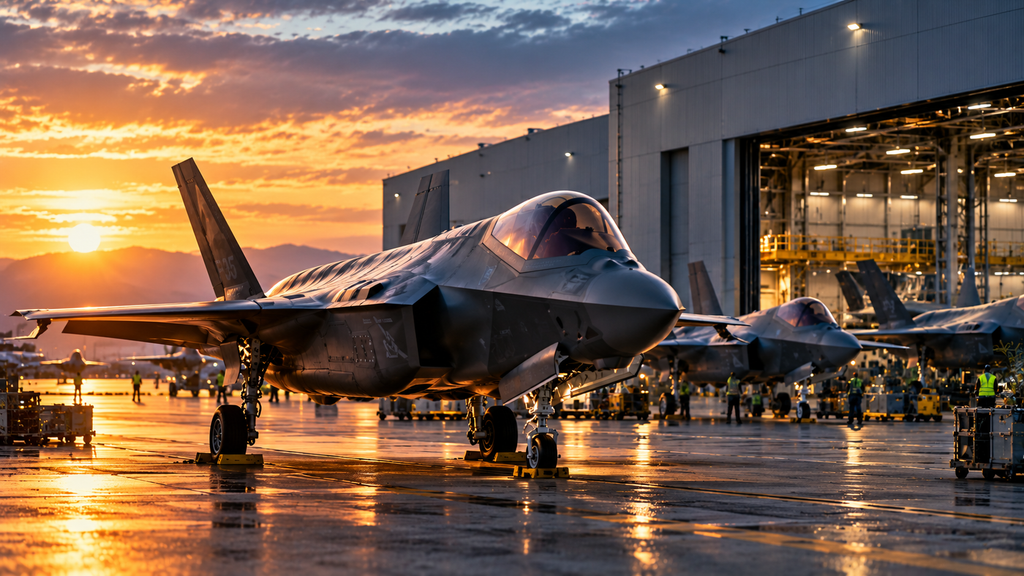
Image: Fighter aircraft assembly and the industrial capacity behind the F-35 programme.
Supply Chain and Manufacturing Capacity
Maintaining production at 156 aircraft per year requires coordination across a large industrial network. Aircraft manufacturing depends on specialist components, advanced materials, electronics, engines and skilled labour, with delays at one supplier potentially affecting final assembly.
A decade-long planning framework can give suppliers more confidence to expand capacity and secure materials in advance. Larger, more predictable orders may also support purchasing efficiencies and reduce disruption caused by repeated short-term negotiations.
Yet higher production targets alone do not guarantee smooth execution. The company must still manage quality control, delivery timing, component availability and costs. If demand rises faster than the supply chain can respond, manufacturing bottlenecks may limit the financial benefits of the agreement.
The programme’s scale therefore creates both opportunity and execution risk: greater visibility can support investment, but the value of that investment depends on delivering aircraft and support services on schedule and within agreed financial terms.
What It Means for Lockheed Martin
The framework strengthens Lockheed Martin’s long-term production outlook at a time when governments are placing renewed emphasis on defence readiness and the replenishment of military inventories.
For the company, the potential benefits include a more predictable production pipeline, stronger supplier planning and an expanded base for sustainment revenue. Its revised sales, earnings and cash-flow forecasts also reflect confidence in near-term demand across its defence portfolio.
The principal uncertainty is the conversion of the framework into fully authorised, funded contracts. Lockheed has separately warned that it remains in negotiations with the US government over production contracts for F-35 Lots 20 and higher. It said insufficient additional contractual authorisation and funding could adversely affect future operating results, cash flow and financial condition.
That qualification matters for investors assessing the headline value. The announced minimum of $78 billion is a significant indication of planned demand, but it should not be interpreted as $78 billion of immediately secured revenue or profit.
Defence Spending Meets Industrial Reality
The F-35 framework illustrates how defence procurement is increasingly being organised around longer-term manufacturing capacity, supply-chain resilience and fleet support rather than aircraft purchases alone.
Lockheed Martin enters the next phase with an improved financial outlook and a record backlog, while the proposed agreement offers a clearer planning horizon for the F-35 production system. Its eventual economic impact will depend on approvals, appropriations, final contract terms and the company’s ability to scale production efficiently.
The announcement is therefore a major step toward a decade of planned demand—not the end of the contracting process. For the defence industry, the challenge now is turning long-term commitments into reliable deliveries, operational readiness and sustainable financial returns.