
Gold’s sharp correction is colliding with a more restrictive interest-rate outlook. JPMorgan Private Bank sees further downside risk as thin market liquidity, rising bond yields and expectations of additional Federal Reserve tightening challenge the precious metal’s recovery.
◉ Higher rates threaten gold: Expectations of further US monetary tightening could increase the opportunity cost of holding a non-yielding asset.
◉ The $4,000 level is under pressure: Gold’s recent retreat has left the market vulnerable to further volatility, with analysts watching whether prices can establish a durable floor.
◉ Long-term support remains: Central-bank demand and gold’s role as a hedge against economic and currency risks could help underpin a recovery once interest rates peak.
Gold’s Rally Meets Resistance
Gold’s latest downturn reflects a shift in the forces that powered its earlier advance. Higher energy prices have intensified inflation concerns, supported expectations of tighter monetary policy and helped keep pressure on the precious metal.
Yuxuan Tang of JPMorgan Private Bank has warned that gold remains exposed to further declines as market liquidity stays thin and interest rates may have further room to rise. The central issue is no longer simply how far prices have fallen, but whether the macroeconomic conditions behind the sell-off are beginning to ease.
Why Rates Matter
Unlike government bonds, gold generates no interest income. When Treasury yields rise, investors can earn more from interest-bearing assets, increasing the relative cost of holding bullion. A stronger US dollar can add another headwind by making gold more expensive for buyers using other currencies.
The pressure is becoming visible in market forecasts. A Reuters poll published on October 27 found that analysts had lowered their median forecast for the average 2026 gold price to $4,495 an ounce, from $4,509 in the previous survey. The same poll projected a modestly higher average of $4,650 for 2027, suggesting that expectations for near-term weakness have not eliminated the possibility of a later recovery.
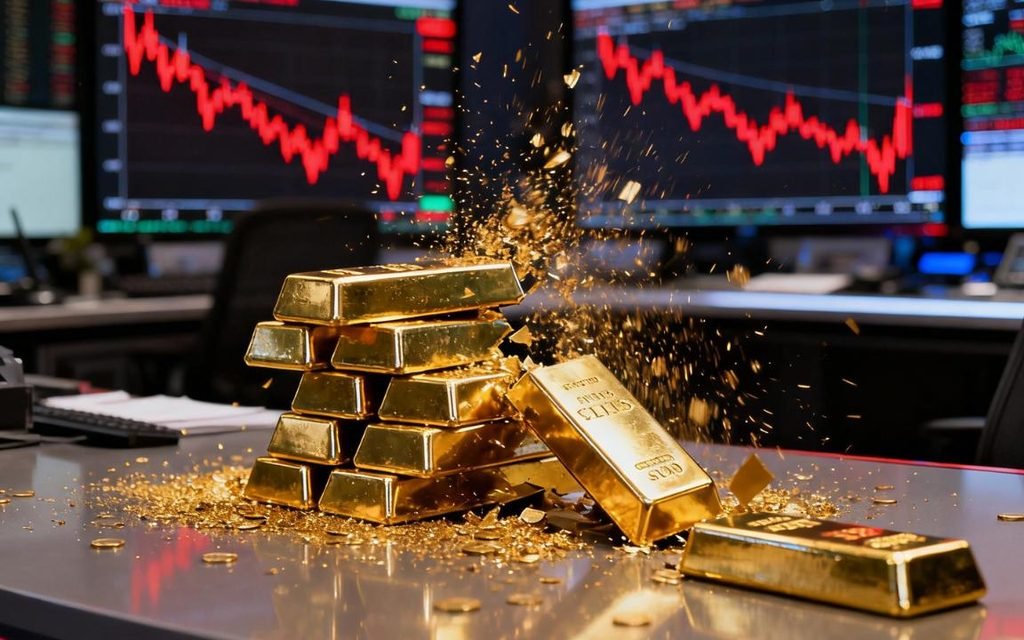
The Market Searches for a Floor
Gold recently retreated towards the $4,000-per-ounce area after reaching a record high of $5,595 in January. On October 28, Reuters reported that spot gold was down 0.7% at $4,030.20, as oil-driven inflation concerns weighed on prices ahead of the Federal Reserve’s policy decision.
Technical levels matter, but the durability of any recovery may depend more heavily on yields, the dollar and investor positioning. Standard Chartered has also warned that gold could face a deeper correction if it fails to establish support, while pointing to central-bank and Asian physical demand as potential sources of resilience.
A Divided Outlook
The gold market is balancing two different time horizons. In the near term, elevated yields and the possibility of further rate increases create a difficult environment for bullion. Over a longer period, persistent fiscal concerns, reserve diversification and demand for protection against economic uncertainty may offer support.
That leaves a key distinction for markets: a correction driven by interest rates does not necessarily invalidate gold’s longer-term role as a hedge. But that role alone does not guarantee a price recovery, particularly while liquidity is fragile and competing assets offer increasingly attractive yields.